
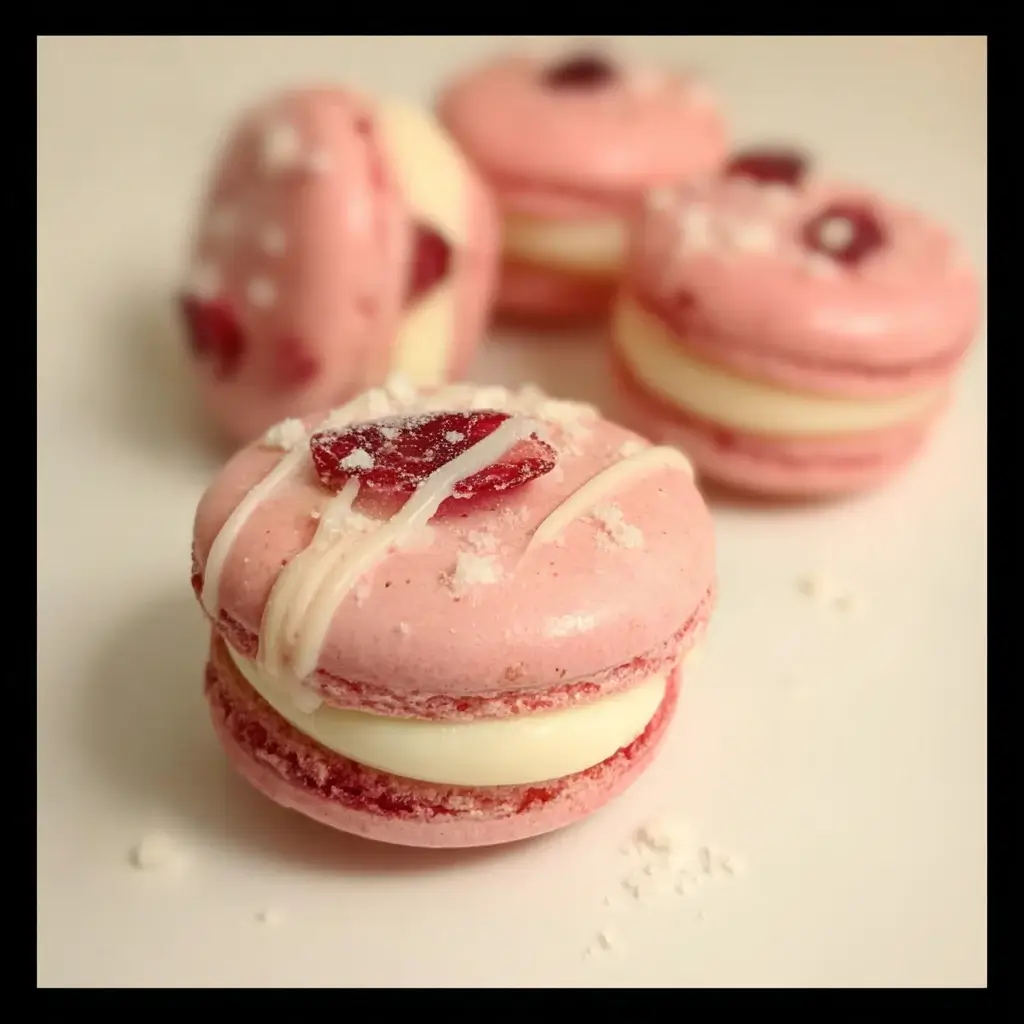
There are certain baking projects that feel like a rite of passage for a home baker, and at the very top of that list sits the elusive French Macaron. For years, I admired them from afar—those perfect, jewel-like cookies with their smooth, domed tops and the signature frilly “feet.” They seemed like a form of culinary magic, a delicate art form I was too intimidated to attempt. My first few tries were, to put it mildly, a disaster. I had cracked shells, hollow shells, shells that spread into flat, sad puddles. I was ready to give up. But the dream of creating my own perfect macarons wouldn’t let me go. I researched, I practiced, and I slowly began to understand their secrets. This Cranberry White Chocolate Macaron recipe is the culmination of that journey, and it is, without a doubt, the most rewarding cookie I have ever made.
I first developed this flavor combination for a Christmas cookie exchange, wanting something that was both visually stunning and tasted unequivocally festive. The result was nothing short of breathtaking. The delicate, almond-scented shells give way with a gentle crackle to a chewy, luxurious interior. In the center is a vibrant, ruby-red swirl of tart cranberry filling, its bright acidity perfectly cutting through the sweet, creamy indulgence of a luscious white chocolate ganache that surrounds it. They are a symphony of textures and flavors in a single, perfect bite. When I presented them, my friends were speechless. They couldn’t believe they were homemade. Seeing the look of pure delight on their faces as they bit into one was worth every single failed batch that came before. These macarons aren’t just cookies; they are a statement, a special occasion, and a testament to the fact that with a little patience and a great recipe, you can create true magic in your own kitchen.
The Ultimate Guide to Festive Cranberry White Chocolate Macarons
Welcome to your comprehensive masterclass for creating exquisite Cranberry White Chocolate Macarons. This is not just a recipe; it’s a detailed guide filled with the essential tips, techniques, and troubleshooting advice you’ll need to conquer the French macaron. While they demand precision, the process is incredibly rewarding. Prepare to create a dessert that is as beautiful as it is delicious.
Complete Ingredients for Macaron Perfection
Macarons are a science, and precision is non-negotiable. For this reason, all ingredients for the shells are listed in grams. Using a kitchen scale is the single most important step for success.
For the Macaron Shells (French Meringue Method):
- Super-Fine Almond Flour: 125g. It must be blanched and super-fine for a smooth shell.
- Powdered Sugar (Confectioners’ Sugar): 125g.
- Aged Egg Whites: 100g (from about 3 large eggs), at room temperature.
- Granulated Sugar: 100g.
- Cream of Tartar: ¼ teaspoon. This helps stabilize the egg whites.
- Pink or Red Gel Food Coloring: A few drops (optional, but recommended for visual appeal).
- A Pinch of Salt.
For the Luscious White Chocolate Ganache:
- High-Quality White Chocolate: 6 ounces (170g), finely chopped. Do not use white chocolate chips, as they contain stabilizers.
- Heavy Cream: ⅓ cup (80 ml).
For the Tart Cranberry Filling:
- Fresh or Frozen Cranberries: 1 cup (100g).
- Granulated Sugar: ¼ cup (50g).
- Water: 2 tablespoons.
- Orange Zest: 1 teaspoon (optional, but adds a lovely brightness).
A Deeper Look at the Critical Ingredients
- Aged Egg Whites: This is a classic macaron technique. To “age” egg whites, simply separate them into a clean glass bowl, cover with plastic wrap, poke a few holes in the wrap, and let them sit in the refrigerator for 24-48 hours. This process allows some of the water content to evaporate, resulting in a stronger, more stable meringue. Don’t forget to bring them to room temperature for at least an hour before you start whipping.
- Almond Flour vs. Almond Meal: You must use super-fine, blanched almond flour. Almond meal contains the skins and has a coarser texture, which will result in bumpy, lumpy macaron shells.
- Gel Food Coloring: Liquid food coloring will add too much moisture to your batter and can ruin the delicate structure of the meringue. Gel-based food coloring is highly concentrated and is the only type you should use for macarons.
Step-by-Step Instructions: Your Path to Perfect Macarons
Follow these instructions with care and precision. The process is broken down into manageable stages. Read through the entire recipe before you begin.
Part 1: Preparation (Mise en Place)
- Prepare Baking Sheets: Line two large baking sheets with parchment paper or silicone macaron mats. If you’re using parchment, you can print a macaron template to place underneath to guide your piping.
- Sift, Sift, and Sift Again: In a large bowl, add the 125g of almond flour and 125g of powdered sugar. Sift them together through a fine-mesh sieve at least twice. This step is non-negotiable for achieving a smooth, glossy shell. Discard any large almond lumps that remain in the sieve. Set the sifted mixture aside.
- Prepare Egg Whites: Ensure your 100g of aged egg whites are at room temperature. Wipe the bowl and whisk attachment of your stand mixer with a little vinegar to remove any traces of fat or grease, which can prevent your meringue from whipping properly.
Part 2: Making the French Meringue and the “Macaronage”
- Start the Meringue: Add the egg whites, cream of tartar, and salt to your clean stand mixer bowl. Using the whisk attachment, begin whipping on medium-low speed until the mixture becomes foamy and opaque, like bubble bath (about 2-3 minutes).
- Add the Sugar: Once foamy, increase the speed to medium. Slowly and gradually, begin adding the 100g of granulated sugar, about one tablespoon at a time. Allow about 30 seconds between each addition. This slow process helps create a strong, stable meringue.
- Whip to Stiff Peaks: After all the sugar has been added, increase the speed to medium-high. Add your gel food coloring at this stage. Continue to whip for another 5-8 minutes, until the meringue is very stiff, thick, and glossy. You’ll know it’s ready when you can lift the whisk and the meringue holds a stiff peak that stands straight up without flopping over (often called a “bird’s beak”). The meringue should also stay in the bowl if you carefully turn it upside down.
- Perform the Macaronage: This is the most critical and delicate step of the entire process, where you combine the dry ingredients with the meringue. Add about one-third of your sifted almond flour/sugar mixture to the meringue. Using a flexible spatula, gently fold it in. Then, add the remaining dry ingredients. Now, begin the “macaronage” technique: fold the batter by scraping around the edge of the bowl and then pressing the spatula down through the middle. You are essentially deflating the meringue in a controlled way. Continue this scrape-and-press motion until the batter reaches the “ribbon stage.”
- Test for the Ribbon Stage: The batter is ready when it flows off the spatula like slow-moving lava or a thick ribbon. You should be able to “draw” a figure-8 with the batter falling from the spatula without it breaking. The ribbon of batter that falls back into the bowl should slowly disappear back into the surface in about 20-30 seconds. If it’s too thick, give it a few more folds. If it’s too thin and runny, you’ve gone too far, and unfortunately, the batter cannot be saved.
Part 3: Piping and Resting the Shells
- Prepare the Piping Bag: Transfer the finished batter to a large piping bag fitted with a small, round tip (like a Wilton 12).
- Pipe the Macarons: Holding the piping bag completely perpendicular to the baking sheet, pipe 1.5-inch circles onto your prepared sheets, leaving about 1 inch of space between each one.
- Release Air Bubbles: Once you’ve piped all your shells, firmly rap each baking sheet hard on the countertop 4-5 times. This forces any trapped air bubbles to the surface. Use a toothpick to pop any remaining bubbles to prevent your shells from cracking during baking.
- Rest the Shells: Let the piped macarons sit at room temperature for 30-60 minutes, or until they form a dry skin. This is another crucial step. You should be able to gently touch the top of a shell without any batter sticking to your finger. The timing will depend on the humidity in your kitchen. This dry skin is what forces the macarons to bake upwards, creating their signature “feet.”
Part 4: Baking and Cooling
- Preheat Oven: While the shells are resting, preheat your oven to 300-325°F (150-165°C). Ovens vary wildly, so you may need to experiment to find the perfect temperature for your specific oven.
- Bake: Bake the macarons, one sheet at a time, on the middle rack for 14-18 minutes. To check for doneness, gently nudge the top of one shell. If it wiggles from its base (the “feet”), it needs more time. If it feels firm, it’s done.
- Cool Completely: Let the macaron shells cool completely on the baking sheet for at least 30 minutes before attempting to peel them off the parchment or mat. Trying to remove them while warm will cause them to stick and break.
Part 5: Making the Fillings
- For the Cranberry Filling: In a small saucepan, combine the cranberries, sugar, and water. Cook over medium heat, stirring occasionally, until the cranberries burst and the mixture thickens into a jam-like consistency (about 10-15 minutes). Stir in the orange zest. Let it cool completely. For a smoother filling, you can blend it and strain it through a sieve.
- For the White Chocolate Ganache: Place the finely chopped white chocolate in a heatproof bowl. In a small saucepan, heat the heavy cream until it just begins to simmer. Pour the hot cream over the white chocolate and let it sit for 5 minutes. Whisk until the mixture is completely smooth and emulsified. Let the ganache cool at room temperature, then refrigerate for about 30-60 minutes, until it has thickened to a pipeable consistency.
Part 6: Assembly and Maturation
- Pair the Shells: Match up your cooled macaron shells into pairs of similar sizes.
- Fill the Macarons: Transfer the thickened white chocolate ganache to a piping bag fitted with a round tip. Pipe a “dam” or ring of ganache around the outer edge of one macaron shell from each pair. Fill the center of the ring with about ¼ teaspoon of the cooled cranberry filling. Gently place the matching shell on top and press lightly to sandwich them together.
- Mature the Macarons: This final step is the secret to the perfect macaron texture. Place the assembled macarons in an airtight container and refrigerate them for at least 24 hours. This allows the fillings to soften the inside of the shell, creating that signature crisp-then-chewy texture.
- Serve: Bring the macarons to room temperature for about 20-30 minutes before serving for the best flavor and texture.
Nutrition Facts
Please note that these values are an estimate and can vary based on the exact size of your macarons and the specific brands of ingredients used.
- Servings: Makes about 25-30 filled macarons
- Calories per serving (1 macaron): Approximately 90-110 calories
Preparation Time
Macarons are a project, but the active time is manageable. The waiting times are essential.
- Active Prep Time: 1 hour 15 minutes
- Resting & Cooling Time: 1 hour 30 minutes
- Maturation Time: 24 hours
- Total Time: Approximately 27 hours
How to Serve Your Cranberry White Chocolate Macarons
These beautiful cookies deserve a special presentation.
- The Importance of Maturation: As mentioned, the 24-hour maturation period in the fridge is key. Serving them right after assembly will result in a crunchy, hollow-feeling cookie. The wait is worth it for that perfect texture.
- Room Temperature is Best: Always serve macarons at room temperature. This allows the ganache to soften slightly and the flavors to become more pronounced.
- Create a Dessert Tower: For a stunning party centerpiece, arrange the macarons on a tiered dessert stand or build a macaron tower.
- As a Gourmet Gift: These macarons make an exquisite homemade gift. Carefully package them in a beautiful box with small compartments or separated by parchment paper to protect them.
- Perfect Pairings:
- Serve alongside a cup of hot tea or a cappuccino.
- They are an elegant accompaniment to a glass of champagne or Prosecco.
- Plate them with a few fresh berries to complement the cranberry filling.
5 Additional Tips for Absolute Perfection
- Weigh, Don’t Measure: This is the golden rule of macarons. Volume measurements (cups) are far too inaccurate for this precise pastry. A digital kitchen scale is your most important tool and the number one key to consistent success.
- Know Your Oven: Ovens are notoriously inaccurate. An oven thermometer is a baker’s best friend and will tell you the true temperature inside. Macarons are very sensitive to heat; too hot and they can crack or burn, too cool and they won’t develop feet. You may need to experiment with a small test batch to find your oven’s sweet spot.
- Humidity is the Enemy: Avoid making macarons on a very humid or rainy day. The extra moisture in the air can prevent the shells from drying properly and can make the meringue weepy. If you must bake on a humid day, you may need to extend the resting time significantly.
- Don’t Under-Whip or Over-Whip: A stable meringue is the foundation of a good macaron. Under-whipped meringue won’t be strong enough to support the dry ingredients. Over-whipped meringue can become grainy and break. The “stiff peak” test is your best guide—the peak should point straight up without curling.
- Be Patient with the Macaronage: This step has a steep learning curve. It’s better to be cautious and under-mix, testing frequently, than to over-mix. One or two extra folds can be the difference between a perfect batter and a runny, unusable mess. Take your time, and with practice, you’ll develop a feel for the correct consistency.
Frequently Asked Questions (FAQ)
1. Why did my macaron shells crack on top?
Cracking is usually caused by one of three things: trapped air bubbles (be sure to rap the trays firmly), an oven that is too hot, or not resting the shells long enough to form a proper skin before baking.
2. Why don’t my macarons have “feet”?
The lack of those signature frilly feet is most often due to the shells not resting long enough to form a dry skin. This skin forces the air to escape out the bottom, creating the feet. It can also be caused by a batter that is too wet, either from an unstable meringue or from over-mixing during the macaronage stage.
3. Why are my macaron shells hollow?
Hollow macarons are a common and frustrating problem. The culprit is often an unstable or under-whipped meringue that couldn’t support the structure during baking. It can also be caused by an oven temperature that is too high, causing the shells to rise too quickly and then collapse, leaving a gap.
4. Can I reduce the amount of sugar in the recipe?
Unfortunately, no. The high sugar content is absolutely essential for the chemical structure of a macaron shell. It stabilizes the meringue and creates the unique crisp-and-chewy texture. Reducing it will result in a failed batch.
5. How should I store my finished macarons?
Assembled macarons must be stored in an airtight container in the refrigerator. They are best enjoyed within 3-5 days. They can also be frozen for up to a month. To freeze, place them in a single layer in an airtight container. Thaw them in the refrigerator overnight before bringing them to room temperature to serve.
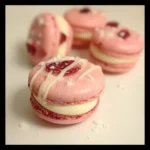
Cranberry White Chocolate Macarons recipe
Ingredients
For the Macaron Shells (French Meringue Method):
-
Super-Fine Almond Flour: 125g. It must be blanched and super-fine for a smooth shell.
-
Powdered Sugar (Confectioners’ Sugar): 125g.
-
Aged Egg Whites: 100g (from about 3 large eggs), at room temperature.
-
Granulated Sugar: 100g.
-
Cream of Tartar: ¼ teaspoon. This helps stabilize the egg whites.
-
Pink or Red Gel Food Coloring: A few drops (optional, but recommended for visual appeal).
-
A Pinch of Salt.
For the Luscious White Chocolate Ganache:
-
High-Quality White Chocolate: 6 ounces (170g), finely chopped. Do not use white chocolate chips, as they contain stabilizers.
-
Heavy Cream: ⅓ cup (80 ml).
For the Tart Cranberry Filling:
-
Fresh or Frozen Cranberries: 1 cup (100g).
-
Granulated Sugar: ¼ cup (50g).
-
Water: 2 tablespoons.
-
Orange Zest: 1 teaspoon (optional, but adds a lovely brightness).
Instructions
Part 1: Preparation (Mise en Place)
-
Prepare Baking Sheets: Line two large baking sheets with parchment paper or silicone macaron mats. If you’re using parchment, you can print a macaron template to place underneath to guide your piping.
-
Sift, Sift, and Sift Again: In a large bowl, add the 125g of almond flour and 125g of powdered sugar. Sift them together through a fine-mesh sieve at least twice. This step is non-negotiable for achieving a smooth, glossy shell. Discard any large almond lumps that remain in the sieve. Set the sifted mixture aside.
-
Prepare Egg Whites: Ensure your 100g of aged egg whites are at room temperature. Wipe the bowl and whisk attachment of your stand mixer with a little vinegar to remove any traces of fat or grease, which can prevent your meringue from whipping properly.
Part 2: Making the French Meringue and the “Macaronage”
-
Start the Meringue: Add the egg whites, cream of tartar, and salt to your clean stand mixer bowl. Using the whisk attachment, begin whipping on medium-low speed until the mixture becomes foamy and opaque, like bubble bath (about 2-3 minutes).
-
Add the Sugar: Once foamy, increase the speed to medium. Slowly and gradually, begin adding the 100g of granulated sugar, about one tablespoon at a time. Allow about 30 seconds between each addition. This slow process helps create a strong, stable meringue.
-
Whip to Stiff Peaks: After all the sugar has been added, increase the speed to medium-high. Add your gel food coloring at this stage. Continue to whip for another 5-8 minutes, until the meringue is very stiff, thick, and glossy. You’ll know it’s ready when you can lift the whisk and the meringue holds a stiff peak that stands straight up without flopping over (often called a “bird’s beak”). The meringue should also stay in the bowl if you carefully turn it upside down.
-
Perform the Macaronage: This is the most critical and delicate step of the entire process, where you combine the dry ingredients with the meringue. Add about one-third of your sifted almond flour/sugar mixture to the meringue. Using a flexible spatula, gently fold it in. Then, add the remaining dry ingredients. Now, begin the “macaronage” technique: fold the batter by scraping around the edge of the bowl and then pressing the spatula down through the middle. You are essentially deflating the meringue in a controlled way. Continue this scrape-and-press motion until the batter reaches the “ribbon stage.”
-
Test for the Ribbon Stage: The batter is ready when it flows off the spatula like slow-moving lava or a thick ribbon. You should be able to “draw” a figure-8 with the batter falling from the spatula without it breaking. The ribbon of batter that falls back into the bowl should slowly disappear back into the surface in about 20-30 seconds. If it’s too thick, give it a few more folds. If it’s too thin and runny, you’ve gone too far, and unfortunately, the batter cannot be saved.
Part 3: Piping and Resting the Shells
-
Prepare the Piping Bag: Transfer the finished batter to a large piping bag fitted with a small, round tip (like a Wilton 12).
-
Pipe the Macarons: Holding the piping bag completely perpendicular to the baking sheet, pipe 1.5-inch circles onto your prepared sheets, leaving about 1 inch of space between each one.
-
Release Air Bubbles: Once you’ve piped all your shells, firmly rap each baking sheet hard on the countertop 4-5 times. This forces any trapped air bubbles to the surface. Use a toothpick to pop any remaining bubbles to prevent your shells from cracking during baking.
-
Rest the Shells: Let the piped macarons sit at room temperature for 30-60 minutes, or until they form a dry skin. This is another crucial step. You should be able to gently touch the top of a shell without any batter sticking to your finger. The timing will depend on the humidity in your kitchen. This dry skin is what forces the macarons to bake upwards, creating their signature “feet.”
Part 4: Baking and Cooling
-
Preheat Oven: While the shells are resting, preheat your oven to 300-325°F (150-165°C). Ovens vary wildly, so you may need to experiment to find the perfect temperature for your specific oven.
-
Bake: Bake the macarons, one sheet at a time, on the middle rack for 14-18 minutes. To check for doneness, gently nudge the top of one shell. If it wiggles from its base (the “feet”), it needs more time. If it feels firm, it’s done.
-
Cool Completely: Let the macaron shells cool completely on the baking sheet for at least 30 minutes before attempting to peel them off the parchment or mat. Trying to remove them while warm will cause them to stick and break.
Part 5: Making the Fillings
-
For the Cranberry Filling: In a small saucepan, combine the cranberries, sugar, and water. Cook over medium heat, stirring occasionally, until the cranberries burst and the mixture thickens into a jam-like consistency (about 10-15 minutes). Stir in the orange zest. Let it cool completely. For a smoother filling, you can blend it and strain it through a sieve.
-
For the White Chocolate Ganache: Place the finely chopped white chocolate in a heatproof bowl. In a small saucepan, heat the heavy cream until it just begins to simmer. Pour the hot cream over the white chocolate and let it sit for 5 minutes. Whisk until the mixture is completely smooth and emulsified. Let the ganache cool at room temperature, then refrigerate for about 30-60 minutes, until it has thickened to a pipeable consistency.
Part 6: Assembly and Maturation
-
Pair the Shells: Match up your cooled macaron shells into pairs of similar sizes.
-
Fill the Macarons: Transfer the thickened white chocolate ganache to a piping bag fitted with a round tip. Pipe a “dam” or ring of ganache around the outer edge of one macaron shell from each pair. Fill the center of the ring with about ¼ teaspoon of the cooled cranberry filling. Gently place the matching shell on top and press lightly to sandwich them together.
-
Mature the Macarons: This final step is the secret to the perfect macaron texture. Place the assembled macarons in an airtight container and refrigerate them for at least 24 hours. This allows the fillings to soften the inside of the shell, creating that signature crisp-then-chewy texture.
-
Serve: Bring the macarons to room temperature for about 20-30 minutes before serving for the best flavor and texture.
Nutrition
- Serving Size: one normal portion
- Calories: 90-110